Skip to Content

Online Exclusive: Public Sector Tools of the Trade

Articles Logan Wamsley Jun 10, 2025

Without some form of baseline evaluation, there is no way to determine how effectively an internal audit function is fulfilling its mandate. This makes it difficult for the function to justify budget, resources, or even its existence.

With public sector internal audit functions already facing limitations regarding budgets and resources, performance measurement becomes even more critical to prove the function’s value to the governing body. Further, establishing a clear, objective process for evaluating the performance of the internal audit function is necessary for conformance to the Global Internal Audit Standards under Standard 12.2 Performance Measurement.

To aid in this task, The IIA recently released a Performance Measurement Tool which outlines, with clear examples and explanations, how to design and implement an effective performance measurement initiative. Although the tool is designed for internal audit functions across all sectors, it may prove particularly valuable within the public sector.

The Importance of Performance Measurement

While the internal audit function is certainly aware of its importance, that viewpoint is not necessarily shared by the rest of the organization. Indeed, according to The IIA’s Vision 2035 report, the top two challenges facing the internal audit profession today are being misunderstood or undervalued (50% of respondents) and lacking sufficient support from leadership (45%). To overcome these challenges, it is not enough for internal audit to proclaim its value. It also needs quantifiable, indisputable proof — and no better proof can be provided than a comprehensive performance measurement evaluation.

Completing such an evaluation, however, can be more difficult for some functions than others.

Unique Challenges in Measuring Internal Audit Performance in the Public Sector

Public sector internal audit functions face a variety of challenges unique to them and their industry that go beyond simple resource constraints. Conducting an accurate performance measurement also offers challenges, including:

  • Diverse stakeholders and objectives. Public sector organizations serve a wide range of stakeholders, including the public, other government bodies, elected officials, and special interest groups, each with varying expectations and priorities. This diversity makes it challenging to define and measure performance in a way that satisfies all parties.  
  • Non-financial objectives. Unlike in the private sector, where financial performance is often the bottom line, public sector organizations pursue a mix of financial and non-financial objectives, such as social welfare and public service delivery. Measuring the effectiveness of the internal audit function in contributing to these non-financial goals often requires different metrics and approaches.
  • Complex regulatory environment. While regulation is not limited to the public sector, public sector internal audit functions often operate within strict legal and regulatory frameworks unique to them. Ensuring compliance and preventing irregularities in these frameworks can sometimes be difficult to quantify.
  • Political influence and sensitivity. Results of audits conducted in the public sector can be politically sensitive, as they may involve scrutiny of government programs, policies, and officials. Maintaining independence and objectivity while measuring performance requires careful consideration of potential political influences and the perspective of the governing body reviewing the evaluation.

Public Sector Value in the Performance Measurement Tool

No matter the challenges facing an internal audit function, The IIA’s Performance Measurement tool is written with broad applicability in mind. “The purpose of the tool was to give some live examples and some broader guidance on how to implement performance measures for the internal audit function,” says James Rose, managing director of Sunhawk Consulting and one of the tool’s primary writers. “And when you think about the overall governance, risk, and controls  environment and trying to develop an overall perspective with metrics around that — whether that's level of coverage, types of review work, whatever the case may be — that applies regardless of industry or the type of organization you're in.”

A Framework to Design a Performance Evaluation

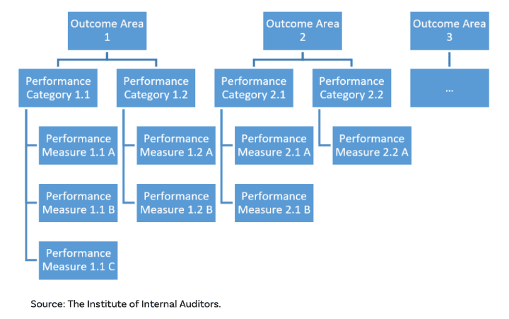
A-Framework-to-Design-a-Performance-Evaluation.png

Where a public sector internal auditor can find particular value in the tool is in the methodology it uses to help auditors clarify variables such as outcome areas, performance categories, the appropriate measures for those categories, and how they fit together to form the basis of a performance measure design (See A Framework to Design a Performance Evaluation).

Within the public sector, these variables may be less clear and require more forethought to define, says Rose. “Thinking about how we interpret overall coverage in the private sector, for instance, you might think in terms of income statements or balance sheets and dissect the main drivers of income. For the public sector, however, I would be looking at what major services our department, agency, or cabinet is providing to the public and the metrics around those services — funding, budgetary requirements, expectations that are supposed to be provided under that budget authority, etc. It is just a slight twist to how to map out what the expectations are.”

It is important to note that often in the public sector many of the areas under the assurance coverage of the internal audit function are non-financial in nature. While qualitative measurements (such as governing body satisfaction) are essential, relying on them exclusively as an objective measurement is difficult. Especially in the public sector, it is critical to have processes in place that provide ongoing measurements. The use of a periodic survey that measures citizen or governing body satisfaction over time, for example, allows the internal audit function to track trends, identify areas for improvement, and adapt to the risks and priorities of the organization or agency. The Performance Measurement Tool offers examples of stakeholder survey questions that can be used to create a quantitative performance metric over time.

Establishing stakeholder expectations is a critical element of any performance evaluation, but in the public sector, it is especially important due to the multiple stakeholders in play. Performance measures should clearly align with the expectations of the stakeholders. “Your job as a chief auditor,” says Rose, “is to understand what stakeholders individually care about and, to the best of your ability, synthesize everything based on that, including your performance metrics.” The Performance Measurement Tool offers several sample performance measures that could be used to determine stakeholder satisfaction.

Stakeholder expectations will also help determine the best way performance measure results should be reported. The tool offers detailed examples of two different approaches an internal audit function can take: the dashboard and the weighted scorecard. Both approaches have merit, and the ultimate decision on how to present findings should be made by the CAE, based on clear alignment with the needs and expectations of the stakeholders.

A Tool to Enhance Current Performance Measurement Processes

Performance measurement is not a new concept for public sector internal audit functions, and in many jurisdictions, it is required by law. But even for the most mature functions, there is still value in reviewing the Performance Measurement Tool. No process is beyond improvement, and as the risk environment grows in complexity, an internal audit function cannot afford to be caught unaware if one aspect of its services is found lacking. Conformance is important, but it is not enough.

“It's not just about establishing a baseline for conformance; it's about ongoing improvement,” says Pamela Powers, director of professional guidance, public sector, at The IIA. “The only way we can get better is through performance measures. Our goal is to have our members look at this new tool as something that can have real positive value in improving the communication with stakeholders.”

Explore more of the Performance Measurement Tool on the IIA website.

Logan Wamsley

Logan Wamsley is associate manager, content development at The IIA.