


How Personal Branding Benefits Female Leaders
Blogs Camila Fernanda Rojas Martínez, CIA, CGAP, IAP, COSO ICC Mar 10, 2026

While internal auditing must always be grounded in strong technical expertise, today’s leaders are also measured by their ability to influence, engage in strategic conversations, and build trust in increasingly complex environments. As a result, personal branding is no longer optional. It is a professional strategy.
Women have made significant progress in the profession, yet perception still influences opportunity. Managing that perception strategically is itself an act of leadership. In the context of female leadership, strong positioning ensures that conversations focus on capabilities and results. A clear professional brand reduces ambiguity and strengthens authority based on demonstrated performance.
Personal branding is not self-promotion. It is consistency. It means that when technical judgment, strategic thinking, or trusted leadership are discussed, your professional identity is naturally associated with those qualities. Professional reputation is built at the intersection of solid preparation, effective communication, and sustained results.
In internal audit, technical excellence remains the foundation. Certifications such as The IIA’s CIA, CRMA, and IAP reflect a commitment to global standards and methodological rigor. However, preparation alone does not guarantee influence. Leadership also requires strategic visibility: participating in professional forums, contributing to technical discussions, writing, representing the function, and clearly communicating the impact of audit work. This is not about unnecessary exposure; it is about intentional positioning.
Professional trends reinforce this need. The IIA’s Risk in Focus reports highlight priorities such as cybersecurity, organizational culture, ESG, reputational risk, and governance. Vision 2035 envisions the auditor as a strategist and trusted advisor. The IIA’s Executive Center emphasizes competencies such as executive communication and influence. Personal branding should align with these evolving expectations.
Influence must be built. It grows when complex risks are synthesized clearly, when recommendations are actionable, and when follow-up is consistent. Every interaction either strengthens or weakens professional reputation.
Leadership does not begin with a title. It is reflected in rigorous preparation, protection of independence, ethical consistency, and the development of teams. Over time, that consistency becomes credibility. And credibility is the foundation of leadership.
Five Phases of Female Leadership and Personal Branding in Internal Auditing
Personal branding and leadership development are not isolated actions. They evolve through interconnected stages. The framework below summarizes how female leadership in internal audit progresses from self-awareness to legacy and transformation.
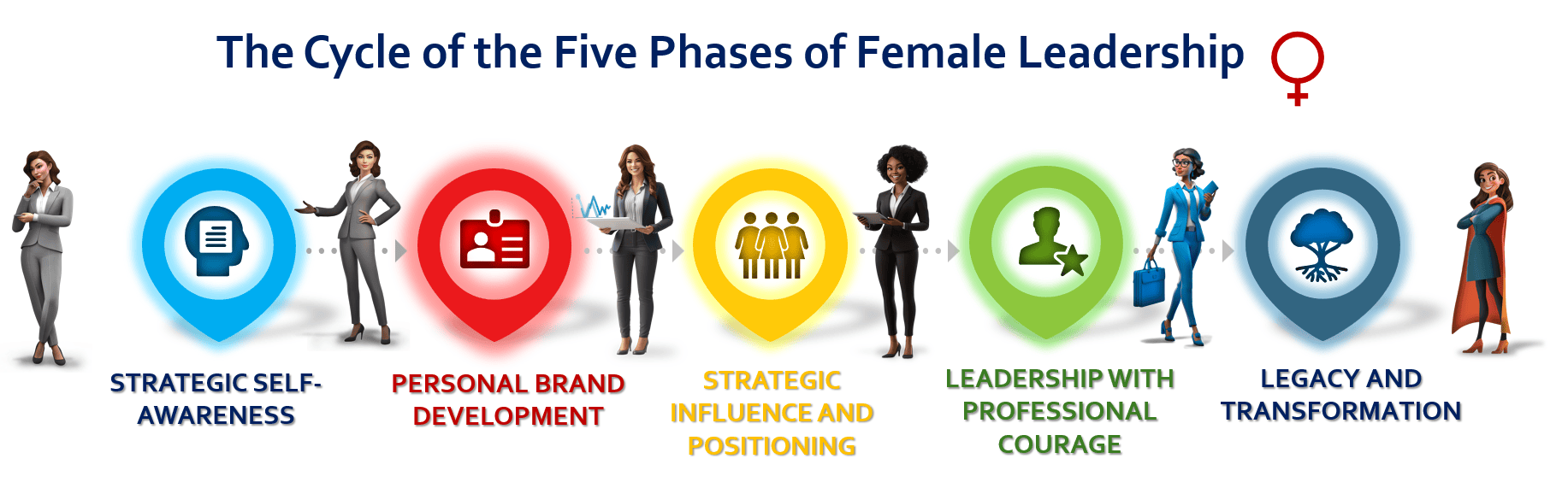
The model illustrates a continuous cycle grounded in purpose and value. Each phase reinforces the next:
1. Strategic Self-Awareness
Clarify your purpose, identify your unique strengths, and assess your leadership style. Ask: What makes me authentic and valuable as an audit leader?
2. Personal Brand Development
Define a clear value proposition, strengthen executive presence, and actively manage your professional reputation internally and externally. Understand what others associate with your name.
3. Strategic Influence and Positioning
Engage in decision-making forums, communicate risk with impact, and build alliances with key stakeholders. The goal is to be recognized as a driver of value and change.
4. Leadership with Professional Courage
Make decisions with integrity, navigate ethical dilemmas, and address bias with clarity and confidence. Courageous leadership opens doors for others.
5. Legacy and Transformation
Mentor future leaders, foster innovation, and position internal audit as a strategic function with human impact. Leadership matures when it leaves a lasting contribution.
Turning Reflection Into Action
Leadership does not consolidate through reflection alone; it requires execution. After developing self-awareness, building a brand, strengthening positioning, exercising professional courage, and defining a vision of legacy, the risk is remaining at a conceptual level. Implementing a structured action plan — supported by feedback and periodic evaluation — transforms intention into measurable progress.
The evolution of female leadership in internal auditing is increasingly visible. Professional networks, international forums, and excellence awards reflect a growing presence of women in strategic roles. These advances are not symbolic; they are the result of preparation, competence, and sustained influence.
Looking ahead, internal auditing will become more strategic, more technological, and more demanding. Organizations expect auditors to anticipate risks, interpret data, and advise at the highest governance levels. In this environment, professional reputation is a strategic asset.
For women in the profession, integrating personal branding into professional development is not about image. It is about clarity and direction. It ensures that expertise is visible, influence is intentional, and executive presence reflects preparation and purpose.
Leadership is not granted. It is built and sustained. In internal auditing, it begins with the decision to position yourself with consistency, courage, and conviction. And every step matters.
The views and opinions expressed in this blog are those of the author and do not necessarily reflect the official policy or position of The Institute of Internal Auditors (The IIA). The IIA does not guarantee the accuracy or originality of the content, nor should it be considered professional advice or authoritative guidance. The content is provided for informational purposes only.