


Assessing Manufacturing Supply Chain Risk
Articles Logan Wamsley May 06, 2026

Source inexpensively, produce where it’s most efficient, and ship everywhere — for decades, these concepts defined the manufacturing supply chain. However, conflicts like the Strait of Hormuz have led to a structural shift away from globalization toward supply chain localization and regionalization.
This transition offers strategic benefits — greater resilience, reduced lead times, improved responsiveness to domestic demand — but it also introduces risks many organizations are unfamiliar with as they upend their long-established models. For internal auditors in manufacturing, this is not a background development to monitor passively. It is an emerging material risk that demands deliberate, structured audit coverage.
Establishing the Risk Landscape
Supply chain localization does not begin with a single organizational decision. It unfolds through interdependent investments, trade-offs, and operational changes stemming from a realization of supply chain vulnerabilities. “Location, at the end of the day, is a concentration risk,” says Neelakantan Venkatachalam, GM, Group Risk Management, at ArcelorMittal, based in Chicago. “It’s a reaction to the long-standing narrative pushing supply chain globalization, which was impacted heavily by COVID. That was when, suddenly, the world realized we are too dependent on one country or one supplier.”
Like any major organizational strategic shift, benefits come with risks that stakeholders must consider. These risks can include:
1. Capital Investment and Infrastructure Risk
Reshoring or nearshoring production requires significant capital investment in new or expanded facilities, updated equipment, retooled processes, and rebuilt logistics networks. These are multi-year commitments made amid regulatory and geopolitical uncertainty. Cost overruns, delayed timelines, and stranded assets are real risks. The CHIPS and Science Act in 2022, for example, created a wave of U.S. semiconductor facility investments from companies like TSMC, Intel, and Samsung.
2. Raw Material Availability Risk
Global supply chains were built because certain raw materials were geographically concentrated. Localizing production, however, does not localize resources. Manufacturers reshoring to North America or Europe may find key inputs — rare earth elements, specialty alloys, agricultural commodities — remain sourced from Asia, Africa, or South America. Recent raw materials shortages in the European Union (EU) are an example of this. “Without critical raw materials, there will be no energy transition, no competitiveness, and no strategic autonomy,” said Keit Pentus-Rosimannus, a member of the European Court of Auditors who published a recent report on this risk for the EU. “Unfortunately, we are now dangerously dependent on a handful of countries outside the EU for the supply of these materials,”
3. Labor Cost and Availability Risk
In the white paper Strategic localization: balancing risk, value, and technology sovereignty in aerospace and defense supply chains, the Aerospace Industries Association said, “The most frequently cited barrier [to onshoring and reshoring] is the limited availability of skilled labor.” Domestic labor markets in advanced economies feature higher wage floors, greater regulatory complexity, and, in many sectors, workforce shortages that could prompt accelerated adoption of artificial intelligence and robotic automation.
4. Supplier Ecosystem Immaturity
Global supply chains benefit from mature supplier ecosystems refined over generations. Localized supply chains could lack qualified domestic suppliers, require extensive supplier development investment, and include significant ramp-up periods, as well as single supplier situations that create a high probability of bottlenecks. The 2024 PwC and Massachusetts Institute of Technology survey “Localising supply chains and its impact on performance,” gathered insights from 130 respondents across 15 countries on organizations that partially localized their supply chains. According to the report, 67% of respondents said that excessive localization leads to a “tipping point” where benefits fade largely due to “inefficiencies, such as over-reliance on constrained local resources, higher operational costs or reduced flexibility to adapt to global market dynamics.”
The Internal Auditor’s Response
The topic of supply chain localization touches on a multitude of risks that are highlighted in The IIA’s 2026 Risk in Focus Report. These include business resilience, regulatory change, geopolitical/macroeconomic uncertainty, competition, governance and corporate reporting, and supply chain (including third parties). Figure 1 shows the respondent rankings of these risks:
Figure 1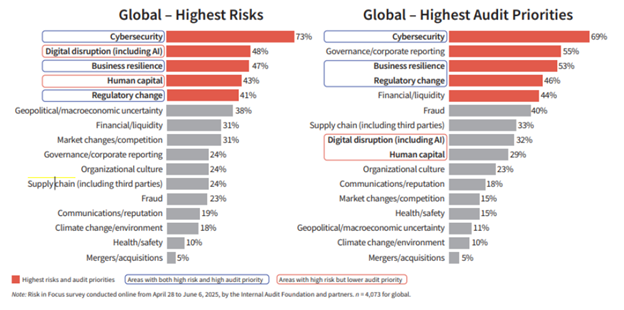
Internal audit teams should determine how a localization strategy affects their organization’s unique landscape, says Venkatachalam. “When a decision is made to restructure the supply chain, you have to question every single aspect of it,” he says. “You have to start right from the strategy of the company, both in the short term and the long term, as well as all of the major capital expenditures, such as new plants or the introduction of new products.”
Internal audit should understand which risk variables in this strategy are controllable and which are not. “A non-controllable could be like, for example, rare earth,” Venkatachalam says. “We have to get it from China. You can’t just create a rare earth here if your country doesn’t have it. So maybe the question an internal auditor would ask is, are you entering into long-term negotiations with the suppliers? Are you logged into a contract that will ensure that you will get your supply of rare earth? If that is the situation, then you can evaluate how the organization is spreading the risk and whether restructuring is or is not warranted.”
Developing the organization’s strategic plan requires time, detailed analysis, and consistent communication with stakeholders. “You have to start right at the top for the strategy,” Venkatachalam says. “And then, once you have got that feedback — particularly for capital expenditures — then you can start to evaluate supply chain impact from there.”
There are several audit-based approaches for conducting such evaluations, Venkatachalam cites. Together, they help internal audit develop a clear understanding of this risk. Examples include:
Strategic Alignment Audits. Auditors can assess whether a localization strategy has been subjected to rigorous business case development — including scenario analysis, labor costs, material prices, policy continuity, and board-level oversight.
Capital Project Monitoring. Large-scale infrastructure investment should be tracked against budgets, timelines, and milestones. As part of this strategy, internal audit can also review project governance structures, change order authorization processes, and the independence and rigor of project oversight functions.
Regulatory Incentive Compliance Reviews. Where government programs incentivized localization decisions, auditors should assess ongoing compliance with program requirements, including domestic content thresholds, employment commitments, and reporting obligations. Failure to maintain compliance can trigger legal repercussions that significantly affect project economics and, in extreme circumstances, organizational stability.
Workforce Risk Reviews. Audit coverage should include talent acquisition strategy, labor cost variance analysis, and assessments of workforce planning assumptions embedded in the localization business case.
A Trend That’s Here to Stay
This trend is unlikely to be short-lived. The PwC survey on supply chains noted, “As disruptions, such as geopolitical tensions, pandemics and climate risks become frequent, the need for effective supply chain strategies has grown and companies are actively reconfiguring their supply chains to better navigate emerging challenges.” Internal audit functions that don’t treat these major reconfigurations as a core enterprise risk will leave their organizations exposed. By embedding supply chain localization risk into audit planning, internal auditors can fulfill their mandate as strategic advisors and maintain their seat at the table alongside key organizational leadership.